On Wednesday, 11th March 2026, the National Renewable Energy Platform (NREP) convened a dissemination workshop at Four Points by Sheraton Kampala to present and discuss the findings of the Social and Behavioral Change baseline study conducted under the Power for Food Programme, implemented with support from SNV Netherlands Development Organisation and the IKEA Foundation. The workshop brought together representatives from government institutions, development partners, civil society organisations, private-sector actors, and farmer organisations to review key insights from a study conducted across Mbale, Jinja, Iganga, Masaka, Mbarara, Ntungamo, Isingiro, Kasese, Kabarole, and Lira. The Power for Food Programme is a five-year initiative running until 2028 and is implemented across several countries to promote the integration of regenerative agriculture and renewable energy in food systems. Findings from the workshop highlighted that while regenerative agriculture practices are already widely adopted by farmers, the use of renewable energy technologies for productive agricultural activities remains limited due to barriers such as high upfront costs, limited access to financing, and limited technical support. The dissemination workshop, therefore, provided an important platform for stakeholders to validate the findings, exchange experiences, and identify practical actions needed to scale integrated solutions that strengthen resilient, productive, and sustainable food systems.
Mr. Carlos Bueso Varela, Power for Food Partnership Lead at SNV Netherlands Development Organisation, gave opening remarks first by expressing appreciation to the National Renewable Energy Platform for convening the national dissemination engagement, noting that such platforms are essential for strengthening dialogue, learning, and collaboration among stakeholders working at the agriculture–energy nexus. He highlighted the critical roles played by the Ministry of Agriculture, Animal Industry and Fisheries, and the Ministry of Energy and Mineral Development in advancing the objectives of the Power for Food Partnership, emphasizing that strong coordination between the two sectors is key to unlocking sustainable agricultural transformation. He also commended the establishment of the Agri-Energy Desk as an important step toward improving institutional coordination and supporting integrated solutions that link renewable energy with agricultural productivity. Mr. Varela further acknowledged the efforts of NREP and its partners in generating evidence, knowledge, and partnerships through the Power for Food Partnership, noting that these collaborative outputs contribute significantly to shaping practical solutions, informing policy dialogue, and strengthening the enabling environment for scaling regenerative agriculture and renewable energy solutions within Uganda’s food systems.
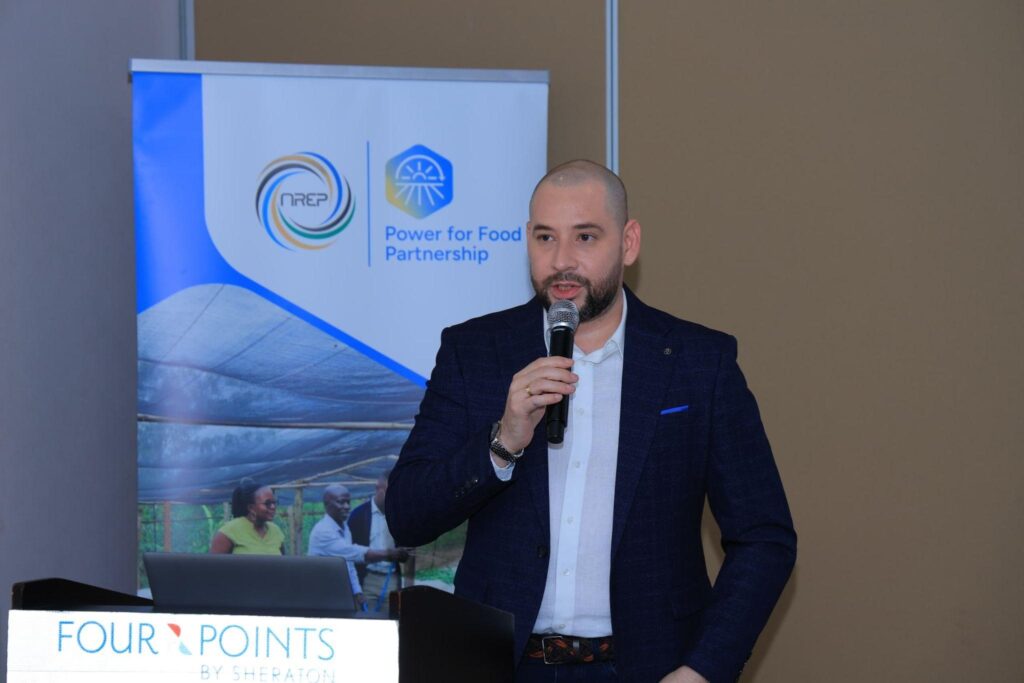
Eng. Elizabeth Kaijuka, Acting Assistant Commissioner in the Renewable Energy Department at the Ministry of Energy and Mineral Development, opened the dissemination workshop with remarks delivered on behalf of the Commissioner, Dr.Brian Isabirye, who was unable to attend due to official commitments. She acknowledged the presence of development partners, including SNV Netherlands Development Organisation and GIZ, alongside representatives from the private sector, farmer organisations, civil society, and government institutions. In her remarks, she emphasized the strong interconnection between agriculture and energy in Uganda’s development agenda, noting that access to reliable and renewable energy is essential for irrigation, processing, storage, and value addition in agricultural value chains. She highlighted the Government’s ongoing efforts to strengthen the productive use of renewable energy through policy development and improved sector coordination, and welcomed initiatives such as the Agri-Energy digital platform that aim to connect farmers with technology providers, finance, and advisory services. She further noted that while awareness of regenerative agriculture practices is growing, structural challenges such as high upfront costs, limited financing, and fragmented initiatives continue to slow the wider adoption of renewable energy solutions. She therefore called for stronger collaboration among government, development partners, the private sector, and farmer organisations to build a coordinated ecosystem that supports sustainable agricultural transformation and resilient rural livelihoods.

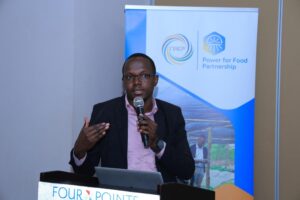
Mark Tusiime, Head of Knowledge Management at the National Renewable Energy Platform (NREP), presented the baseline study findings using a behavioural change framework with five stages: awareness, interest, trial, adoption, and maintenance to examine how farmers and agri-enterprises adopt regenerative agriculture (RA) practices and productive use of renewable energy (PURE) technologies across ten districts. The study, which combined quantitative and qualitative data from farmers, agri-SMEs (particularly women and youth), and institutions such as financial organizations, found that RA is widely practiced, with over 95% of respondents using at least one practice, notably intercropping (79%) and mulching (63%), indicating that many farmers are at the adoption or maintenance stages. In contrast, PURE adoption remains low at 18.5%, with solar-powered irrigation most common at 15.9%, as most farmers remain in the awareness, interest, or early trial stages. Key drivers of adoption include improved productivity, income opportunities, visible peer benefits, and alignment with existing practices, while barriers such as high upfront costs, limited financing, technical confidence gaps, and weak market and service infrastructure constrain uptake. Gender analysis showed high RA adoption across men and women, with women slightly more likely to adopt PURE technologies, whereas youth interest often does not translate into action due to structural limitations such as land access and collateral. District-level differences, such as higher PURE adoption in Jinja and Isingiro, highlighted the role of cooperatives, suppliers, demonstrations, and coordinated institutional support. The study concluded that while communities are willing to adopt new practices and technologies, financial, technical, and institutional constraints limit action, underscoring the need for strengthened coordination, bundled support services, inclusive financing models, and cooperative-based approaches to accelerate integrated RA–PURE adoption across Uganda.
Derrick Locha Mayiku, Principal Systems Lead at NREP, introduced the Digital Agri-Energy Desk, a national platform designed to centralise information on Uganda’s agri-energy sector. The platform aims to consolidate data on projects, technologies, policies, and stakeholders, enabling planners, government institutions, researchers, technology providers, and farmers to access verified evidence, discover initiatives, and identify potential partners efficiently. The Phase 1 prototype includes functionalities such as project searches by sector or region, detailed project information, access to reports and guidelines, partner identification, and district-level project mapping. Designed to be user-friendly and expandable, the platform will eventually allow stakeholders to contribute and collaborate directly while ensuring data reliability through governance measures. Early feedback highlighted the platform’s potential to enhance cooperation, transparency and evidence-based planning, with recommendations for user guides, quality controls, engagement features, and sustainable business models. Overall, the Digital Agri-Energy Desk marks a significant step toward a centralised, interactive, and evidence-driven hub for Uganda’s agri-energy initiatives.
The dissemination workshop concluded that while regenerative agriculture is widely adopted across Uganda, the uptake of renewable energy technologies for productive use remains low due to barriers such as high upfront costs, limited financing, and gaps in technical support, despite clear interest and potential among farmers and agri-enterprises. Stakeholders emphasized that achieving resilient and sustainable food systems will require stronger coordination between the agriculture and energy sectors, alongside practical, field-based approaches and improved access to resources. As next steps, partners will focus on strengthening joint planning and government engagement, operationalizing the Digital Agri-Energy Desk as a central coordination platform, expanding inclusive financing options, and scaling demonstrations and cooperative-based models to accelerate the adoption of integrated agri-energy solutions.