The Renewable Energy Training Centre (RETC) continues to play a vital role in strengthening Uganda’s clean energy sector through practical, hands-on training and capacity building. Established in 2016, the Centre is dedicated to equipping technicians, students, and professionals with the skills needed to design, install, and maintain modern renewable energy systems, contributing to innovation, job creation, and expanded energy access across the country.
On 28th March 2026, RETC hosted electrical engineering students from Nakawa Vocational Training College for a practical session on its 10kWp solar photovoltaic system. Guided by their instructor, Mr. Fred Onyango, the students explored key system components including the charge controller, interconnected inverters, battery storage, and the AC consumer unit. The session emphasized how these components communicate through integrated cables and software-configured interfaces, bringing classroom concepts to life.
Through its strong focus on experiential learning, RETC ensured that trainees not only understood renewable energy technologies but could confidently apply them in real-world settings. Mr. Onyango consistently linked each component to prior coursework, deepening the students’ technical understanding and reinforcing the Centre’s commitment to competence-based training.
A separate visit took place on 2nd April 2026 under the Green Energy for Women and Youth Resilience in East Africa – Bridging the Skills Gap through Technical and Vocational Education (BES-TVET) project. Like the previous visitors, the students also examined the solar array of the fully solar-powered facility. They learned that the 10kW system is divided into four arrays, each consisting of four 330W panels feeding into a 48V storage system with two MPPT charge controllers. The trainer explained that the panel tilt encourages self-cleaning by allowing rainwater to wash off dust and leaves.
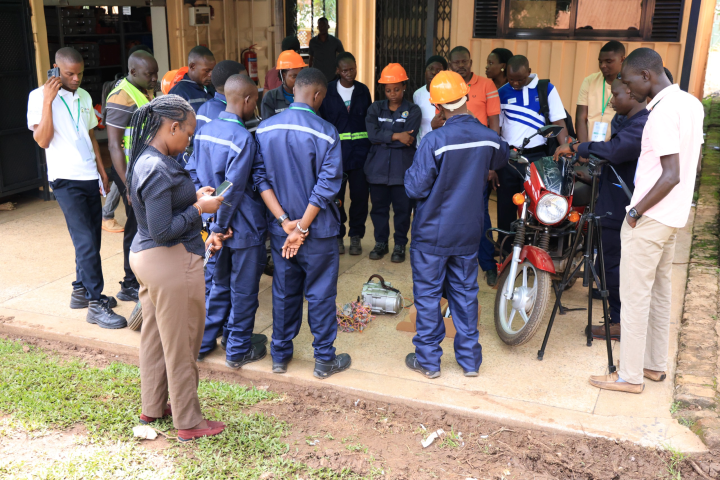
Students further explored the Lithium-Ion battery bank arranged in parallel, three single-phase inverters delivering three-phase output, and the need for additional software for proper phase alignment. The session also introduced e-mobility technologies, with Mr. Zerubabel explaining the transition from fossil fuel engines to electric motors powered by batteries and the role of converters in charging. He emphasized important safety measures, such as disconnecting the power cable and allowing time for residual current to dissipate before maintenance.
With the entire RETC facility powered by solar energy, both visits underscored the immense yet still largely untapped potential of solar power in Uganda. As RETC advances its mission to train skilled professionals and support the country’s clean energy transition, these engagements highlight the critical role of hands-on education particularly in emerging areas like e-mobility in unlocking sustainable energy solutions for the future.
Explore the Renewable Energy Training Center (RETC)
A leading initiative dedicated to strengthening Uganda’s renewable energy sector through high-quality technical training and capacity building.